Insurance Claim Documents: A Practical Guide
This guide explains how to prepare 보험금 청구 서류, submit an insurance claim, and respond to requests for additional evidence. Insurance claim documents generally verify the policyholder’s identity, the insured event, medical or financial loss, and the payment account. Requirements vary by product, claim type, insurer, and claim amount, so applicants should review the policy wording and the insurer’s current instructions before filing. Clear records and consistent information can reduce avoidable delays.
What 보험금 청구 서류 Are Designed to Prove
When a policyholder submits an insurance claim, the insurer must determine whether the reported event is covered by the contract, whether the claimant is entitled to payment, and how much should be paid under the policy terms. The central purpose of 보험금 청구 서류 is to provide evidence for those decisions. Documents are not merely administrative attachments; together, they establish the connection between the policy, the insured person, the event, the resulting loss, and the requested benefit.
In practical terms, most claims involve four questions. First, is the person submitting the claim the policyholder, insured person, beneficiary, or an authorized representative? Second, did the insured event occur during the period of coverage? Third, does the evidence show the medical condition, accident, property damage, death, or other event described in the policy? Fourth, does the requested amount correspond with the contract’s benefit schedule, limits, exclusions, deductibles, and payment conditions?
The exact document list depends on the type of insurance. A hospital treatment claim may require a claim form, identity verification, medical receipts, and treatment details. A death benefit claim may require documents confirming the death and the beneficiary’s entitlement. A vehicle claim may rely on an accident report, repair estimate, photographs, and ownership information. A property claim may require proof of damage, purchase records, repair invoices, and evidence that the claimant had an insurable interest.
Because insurers use different forms and digital systems, there is no single universal checklist. A document accepted for one product may not satisfy another product’s requirements. The safest method is to identify the policy first, classify the claim, and then confirm the current submission instructions with the relevant insurer or its official customer service channel.
The Core Document Categories
Although individual requirements vary, 보험금 청구 서류 can generally be organized into several categories. Understanding these categories makes the preparation process more systematic and helps applicants identify missing evidence before submission.
| Document category | Typical purpose | Common examples |
|---|---|---|
| Claim identification | Shows who is making the claim and under which policy | Claim form, policy number, identity verification, contact details |
| Event verification | Confirms that the insured event occurred | Medical records, accident report, death certificate, police report, incident statement |
| Loss or treatment evidence | Shows the financial or medical effect of the event | Medical receipts, itemized treatment statements, repair estimates, invoices |
| Entitlement evidence | Establishes the claimant’s right to receive payment | Beneficiary documents, family relationship records, authorization forms |
| Payment information | Allows the insurer to transfer approved benefits | Bank account confirmation, account holder information, payment instruction |
| Additional evidence | Resolves questions about coverage, causation, or amount | Specialist opinion, employment records, photographs, investigation materials |
This classification also explains why one document rarely proves everything. A hospital receipt may show that a payment occurred, but it may not identify the diagnosis or treatment category. A diagnosis certificate may describe a condition, but it may not establish the actual amount paid. A photograph may show damage, but it may not prove ownership or the cost of restoration. Insurers therefore evaluate the documents together rather than relying on one item in isolation.
Documents can also be divided into primary and secondary evidence. Primary evidence is usually issued by the institution directly involved in the event, such as a hospital, police station, repair shop, public office, or financial institution. Secondary evidence may include the claimant’s written explanation, photographs taken by family members, calendars, messages, or personal records. Secondary evidence can be helpful, particularly when a primary record is unavailable, but it may need to be supported by additional information.
Medical Insurance Claims
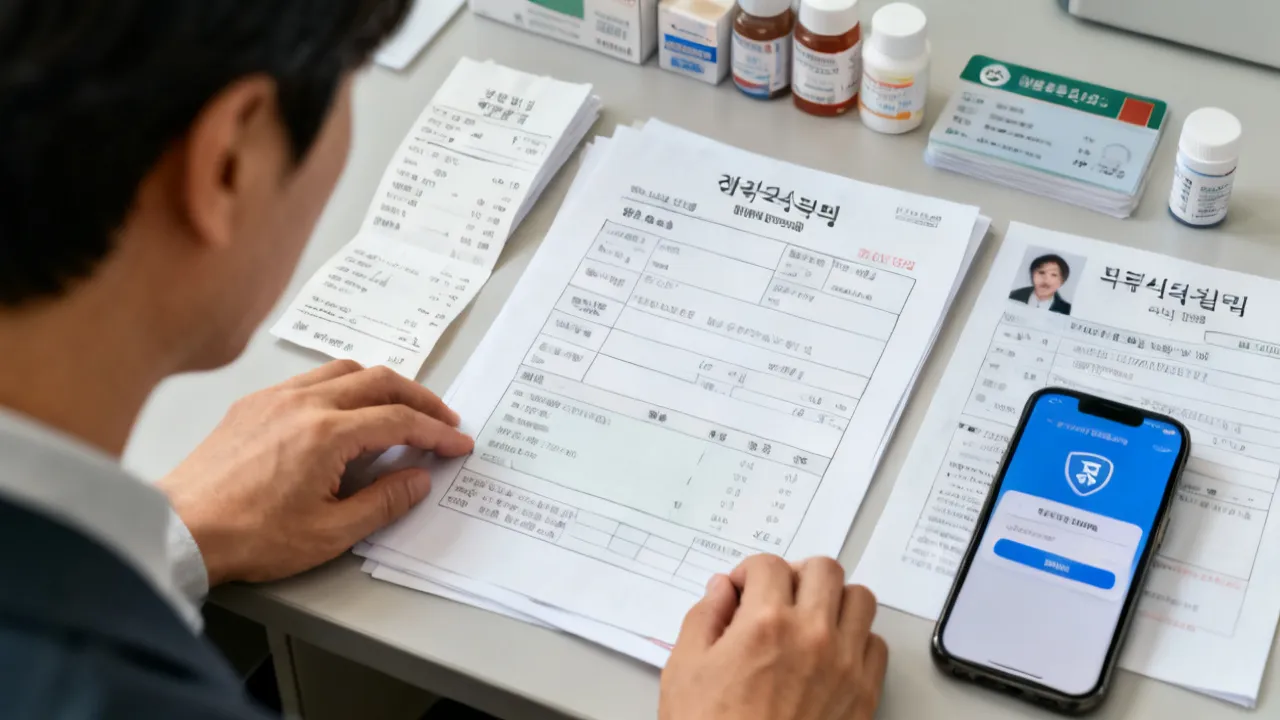
Medical claims are among the most common situations in which people search for 보험금 청구 서류. The basic set often includes a claim form, personal identification information, payment or treatment records, and bank account details. Depending on the policy and the type of treatment, the insurer may also request a diagnosis certificate, medical certificate, surgical confirmation, hospital admission confirmation, prescription record, or itemized statement.
Applicants should distinguish between a simple treatment claim and a claim involving a specific benefit. A routine outpatient reimbursement may focus on the date of treatment, medical institution, treatment category, and amount paid. A surgery benefit may require evidence that the procedure meets the policy’s contractual definition of surgery. A hospitalization benefit may require admission and discharge dates, while a critical illness benefit may depend on diagnostic criteria stated in the policy wording.
Medical terminology can create avoidable confusion. A document may describe a symptom, suspected condition, confirmed diagnosis, procedure, or follow-up recommendation. These terms are not interchangeable in insurance analysis. If the benefit is triggered by a confirmed diagnosis, a document that only records a symptom may not establish eligibility. If the policy defines a procedure in a particular way, a general reference to treatment may not be sufficient.
For that reason, applicants should not alter, summarize, or interpret clinical information in a way that changes its meaning. The safest approach is to submit accurate records and explain the relevant dates and circumstances in plain language. If a document contains an abbreviation or technical term that may affect the claim, the insurer may request clarification from the medical institution or ask for a more specific certificate.
Common medical documents and their roles
- Claim form: Identifies the policy, claimant, event date, and requested benefit.
- Medical receipt: Shows that a medical expense was paid and identifies the provider.
- Itemized treatment statement: Breaks down services, medicines, procedures, or charges.
- Diagnosis certificate: Confirms a diagnosis when the policy requires formal diagnostic evidence.
- Medical certificate: Provides information about treatment, injury, recovery, or functional impact.
- Admission and discharge confirmation: Verifies the duration of hospitalization.
- Surgical confirmation: Describes the procedure and may help determine whether a contractual surgery benefit applies.
- Prescription or medication record: Supports claims involving prescribed medicines or pharmacy expenses.
Not every medical claim requires every item on this list. Requiring a diagnosis certificate for every minor outpatient expense would create unnecessary work, while omitting detailed medical evidence from a major benefit claim could make coverage assessment difficult. Insurers commonly apply different requirements according to the product, claim amount, event type, and the clarity of the initial records.
Outpatient, inpatient, and pharmacy claims
Outpatient claims generally involve shorter treatment periods and smaller individual expenses, but the applicant should still verify that each receipt identifies the patient, provider, treatment date, and amount paid. If several visits relate to one condition, submitting them in chronological order can help the insurer understand the course of treatment. Pharmacy claims may require a prescription or medication statement in addition to the payment receipt, particularly where the policy distinguishes between covered and non-covered medicines.
Inpatient claims may require evidence of the admission date, discharge date, room or treatment category, procedures performed, and total expenses. A hospital bill alone may not answer whether the insured was formally admitted under the policy’s definition of hospitalization. When a daily hospitalization benefit is claimed, the number of covered days may be calculated differently from the number of calendar days spent at a medical facility.
Applicants should also be aware that medical records may contain services that are not covered under the relevant policy. A receipt showing a total payment does not necessarily mean that the entire amount is reimbursable. The insurer may separate covered treatment, non-covered treatment, deductibles, co-payments, and expenses subject to a benefit limit.
Accident, Injury, and Disability Claims
Accident-related claims often require more than proof of treatment. The insurer may need to understand how the accident occurred, whether the injury is consistent with the reported circumstances, when treatment began, and whether a lasting impairment resulted. Relevant 보험금 청구 서류 can include an accident statement, emergency room record, medical certificate, imaging report, police documentation, witness information, or employment-related evidence.
An accident statement should be factual and chronological. It should identify the approximate time, location, activity, mechanism of injury, immediate symptoms, and treatment received. Speculation about legal responsibility or medical causation should be separated from the factual description. If the applicant is unsure of an exact time or sequence, it is better to state that uncertainty than to provide a precise detail that later conflicts with official records.
Disability claims require particular care because the policy definition may differ from everyday use of the word “disabled.” Some contracts refer to permanent impairment, loss of function, loss of use, or a specified degree of disability. The required evidence may include a specialist assessment, functional examination, test results, and a certificate using the insurer’s designated form. The existence of a medical condition does not automatically establish eligibility for a contractual disability benefit.
Applicants should review the policy’s waiting periods, exclusions, accident definitions, and documentation requirements before requesting a specialist certificate. A certificate that does not address the policy’s relevant criteria may lead to a further request and additional appointments. The insurer’s claim department can usually explain the information that must be included without instructing a medical professional to reach a particular conclusion.
Where an injury develops over time, the chronology becomes especially important. The applicant should preserve records showing the initial incident, first symptoms, initial examination, later diagnosis, treatment progression, and current condition. If there was a gap in treatment, the applicant may explain the reason, such as recovery at home, a change of hospital, financial difficulty, or a medical recommendation. A gap does not automatically defeat a claim, but unexplained gaps can create questions about causation or severity.
Death Benefit and Beneficiary Claims
A death benefit claim involves both the insured event and the claimant’s legal or contractual entitlement. Common documents may include a claim form, death certificate or equivalent official record, identity verification for the beneficiary, proof of the beneficiary relationship where relevant, and bank account information. Depending on the circumstances, the insurer may request medical records, an accident report, investigation materials, or documents concerning multiple beneficiaries.
Beneficiary issues can be more complex than applicants expect. The person who reports the death is not always the person entitled to receive the benefit. The policy may name a specific beneficiary, use a category of beneficiaries, or provide a default order under the contract. In some cases, several beneficiaries must provide information or authorize a representative to act on behalf of the group.
Where the claim involves inheritance, guardianship, incapacity, or a minor beneficiary, additional legal documentation may be needed. These requirements protect the benefit from being paid to the wrong person. Applicants should avoid relying solely on family assumptions and should confirm the beneficiary designation recorded in the policy and the insurer’s current records.
Death claims can also involve sensitive personal information. Documents may contain diagnoses, treatment history, family relationship details, and financial information. Copies should be sent through an authenticated submission channel, and applicants should retain a record of what was provided. Unnecessary personal details should not be distributed to unrelated parties.
If several policies are involved, the family may need to prepare separate claim packets for each insurer. A death certificate or family relationship record may support more than one claim, but each insurer may require its own claim form, consent, or payment instructions. The family should maintain a master checklist so that documents are not misplaced or sent to the wrong company.
Vehicle and Property Insurance Claims
For motor vehicle claims, the necessary documents depend on whether the claim concerns vehicle damage, bodily injury, theft, liability, or another insured risk. Photographs, an accident description, repair estimates, ownership information, driving or registration records, and police or road authority documentation may be relevant. In a collision claim, the insurer may obtain additional information through its own adjuster or claims representative.
Photographs are most useful when they show the overall scene as well as close views of the damage. The time and location should be recorded where possible. Applicants should avoid repairing, discarding, or materially changing damaged property before the insurer has had a reasonable opportunity to inspect it, unless urgent action is required for safety. If emergency repairs are necessary, photographs and invoices should be retained.
Property claims follow a similar principle. The claimant may need to prove that the property existed, that it was damaged by an insured event, and that the claimed amount is reasonable. Useful records can include purchase receipts, warranties, inventory lists, repair invoices, replacement estimates, photographs, building management notices, and reports from relevant authorities or contractors.
In theft claims, a police report may be important because it provides an independent record of the incident. The insurer may also ask for evidence of ownership and information about when the item was acquired, stored, or last seen. An applicant should provide accurate information even if some items have no receipt. Other evidence, such as photographs, serial numbers, warranty records, or financial statements, may help establish ownership, but the insurer will determine whether it is sufficient under the policy.
For vehicle repair claims, an estimate is not always the same as proof of the final loss. The insurer may ask for a final invoice, payment record, or inspection report. Before authorizing extensive work, the policyholder should understand whether the insurer requires prior approval, a designated repair shop, an inspection, or photographs of hidden damage discovered during disassembly.
Step-by-Step Guide to Preparing 보험금 청구 서류
Step 1: Identify the policy and benefit
Begin with the policy schedule, certificate, or insurer account. Identify the relevant product, insured person, coverage section, and benefit name. A single customer may hold several policies with different insurers, and the same event may be relevant to more than one policy. Record the policy number and the insurer’s claim contact information.
Step 2: Define the event clearly
Write a short description of what happened, including the date, place, people involved, and immediate result. For medical claims, note the first treatment date, diagnosis date, admission period, procedures, and payment dates. For property or vehicle claims, note when the damage was discovered, what caused it, and what action was taken afterward.
Step 3: Review the policy conditions
Check the coverage trigger, exclusions, waiting period, deductible, benefit limit, reporting obligation, and any time-related requirement. The policy wording is more authoritative than informal summaries. If a clause is unclear, ask the insurer to explain the relevant section and keep a written record of the response.
Step 4: Obtain primary records
Collect documents from the medical institution, police agency, repair provider, employer, public authority, or other original source. Primary records generally provide stronger evidence than an informal explanation. Ensure that names, dates, identification numbers, and amounts are consistent across documents.
Step 5: Separate required and conditional documents
Create two folders: one for documents clearly required at submission and another for records that may be needed if the insurer asks follow-up questions. This avoids sending excessive information while preserving useful evidence. A document should be relevant, authentic, and proportionate to the claim.
Step 6: Complete the claim form carefully
Use the policyholder’s legal name and provide current contact details. Describe the event consistently with the medical or incident records. If another person submits the claim, indicate the representative relationship and include the required authorization. Read declarations concerning personal information, medical record access, and claim accuracy before signing.
Step 7: Confirm bank account ownership
Payment instructions should identify an account that the insurer is permitted to use under its procedures. If the account holder differs from the beneficiary or policyholder, additional authorization or explanation may be necessary. Incorrect account information can delay payment after the coverage decision has already been made.
Step 8: Submit through an appropriate channel
Depending on the insurer, submission may be available through an online portal, mobile application, email-based process, postal service, branch office, agent, or claims representative. Use an official channel and follow file-size, format, identity verification, and retention instructions. Screenshots of a completed submission may be useful, but the official receipt or acknowledgment is the primary record.
Step 9: Record the submission
Keep copies of the claim form, attachments, submission date, claim reference number, and contact history. If documents were submitted in stages, record which items were provided on each date. This creates a clear timeline if the insurer later states that a document was not received.
Step 10: Respond to additional requests precisely
An additional request should be read as a question about a particular coverage issue, not automatically as a negative decision. Ask which policy provision or factual issue the requested document relates to. Submit a direct response and label each attachment clearly. If a requested record does not exist, explain why and provide any alternative evidence available.
Step 11: Review the decision
When the insurer communicates its decision, examine the approved amount, rejected items, deductions, benefit category, and explanation. If the result differs from your understanding of the contract, request a written explanation and identify the precise clause in dispute. Maintain a calm, document-based record of the discussion.
Building a Claim Timeline
A timeline is one of the simplest tools for organizing a complicated claim. It can be prepared in a spreadsheet, a word-processing document, or a handwritten table. The timeline should include the date, event, source of information, and related document.
| Date | Event | Supporting record |
|---|---|---|
| Event date | Accident, diagnosis, death, theft, or damage occurred | Incident statement, police report, emergency record, photograph |
| First response date | Initial treatment, emergency action, or notification | Hospital record, repair receipt, insurer notification record |
| Follow-up date | Additional treatment, inspection, or repair | Medical record, inspection report, repair estimate |
| Payment date | Expense was paid or loss was quantified | Receipt, invoice, bank transaction record |
| Submission date | Claim and attachments were delivered | Digital acknowledgment, postal tracking, branch receipt |
The timeline should distinguish between the date an event happened and the date a document was issued. For example, a diagnosis certificate issued in June may refer to a diagnosis established in May. Confusing those dates can create an unnecessary inconsistency. If a later document summarizes an earlier event, the applicant can note that relationship in the cover sheet.
Paper Documents and Digital Submission
Digital claim submission can make document handling more convenient, but convenience does not remove the need for accuracy. Scans and photographs should be legible, complete, and arranged in a logical order. The claimant’s name and claim reference should be visible where appropriate, while unnecessary sensitive information should be protected in accordance with the insurer’s instructions.
A useful file naming system includes the document type and date, such as “medical_receipt_2025-03-14” or “accident_statement_2025-03-15.” Applicants should avoid ambiguous names such as “scan1” or “document.” If several pages form one record, combine them in sequence when the submission system allows it. Check that no page is cut off, blurred, upside down, or missing a signature.
Digital photographs of receipts may be rejected or delayed if glare obscures the amount, the provider name, or the treatment date. Place the document on a flat surface, use sufficient light, and capture the entire page. Do not edit the content of a document. Cropping the surrounding background may be acceptable when permitted by the insurer, but changing text, dates, amounts, or markings is not.
Electronic medical records may be issued through a hospital application or another authenticated service. The format and evidentiary value can vary. If the insurer requests a document in a particular form, submit the requested version rather than assuming that a personal screenshot will be sufficient.
Before uploading files, check the portal’s confirmation page and record the claim number. Some systems accept a file upload without completing the final submission step. A file appearing in a temporary upload list may not mean that the insurer has received it. Applicants should look for a final acknowledgment, email confirmation, text message, or status change within the insurer’s system.
Personal Information and Authorization
Insurance claims frequently involve health information, identification details, financial records, and information about family members. These materials should be handled carefully. Before submitting, verify the recipient, the purpose of the request, the retention method, and whether the channel uses appropriate authentication.
If a representative submits the claim, the insurer may require an authorization form, identification documents for both parties, and evidence of the relationship or authority. A caregiver, family member, insurance agent, legal representative, or employer may assist with administration, but assistance does not necessarily establish authority to receive confidential information or payment.
Applicants should be cautious with public messaging platforms and informal email addresses. An insurer may provide a designated address or secure upload function for claim documents. When in doubt, confirm the channel through the insurer’s official customer service number or authenticated account rather than relying on a message received unexpectedly.
Only relevant information should ordinarily be submitted. However, applicants should not conceal a relevant fact or remove a page in a way that changes the record’s meaning. A complete but well-organized submission is generally more useful than a large collection of unrelated documents.
When sending documents for a minor or an incapacitated person, the insurer may request evidence of parental authority, guardianship, or other legal status. When sending documents for a deceased person, the applicant may need to establish beneficiary status or authority to act for the estate. These requirements are not simply formalities; they help prevent unauthorized disclosure and improper payment.
Why Claims Are Delayed
Delays do not always mean that a claim will be rejected. They may arise because the insurer cannot yet verify the event, the claimant’s entitlement, the amount of loss, or the relationship between the event and the claimed benefit. Common administrative causes include inconsistent dates, missing signatures, illegible scans, incorrect policy numbers, incomplete bank information, and documents submitted to the wrong department.
Substantive questions can also require review. Examples include uncertainty about whether a diagnosis meets the policy definition, whether a condition existed before coverage began, whether an accident caused the claimed impairment, whether an exclusion applies, or whether the amount falls within the benefit limit. In these situations, the insurer may seek medical records, specialist views, incident reports, or proof of actual expenditure.
A well-prepared applicant can reduce avoidable administrative exchanges by using a cover sheet that lists the claim reference, event date, claimant, and attachments. The cover sheet should not argue the claim excessively; its purpose is to help the reviewer locate the evidence. A brief timeline can be especially useful where treatment occurred over several dates or multiple institutions.
Another possible source of delay is a mismatch between the benefit claimed and the evidence provided. For example, an applicant may request a surgery benefit but submit only an ordinary outpatient receipt, or request a property replacement amount without showing the original item’s value. Before submitting, compare the requested benefit with the exact evidence needed to establish its trigger and amount.
How to Respond to an Additional Document Request
When an insurer requests more 보험금 청구 서류, first determine whether the request concerns identity, coverage, causation, amount, or entitlement. This classification helps identify the appropriate response. For example, a request for a treatment record usually concerns the medical basis of the claim, while a request for a family relationship certificate may concern beneficiary entitlement.
Ask the following questions:
- Which claim and policy does the request relate to?
- What specific issue will the document clarify?
- Is the requested document mandatory, conditional, or one of several alternatives?
- What date range and document format are required?
- Where and by what deadline should the document be submitted?
- Will an explanation be accepted if the document does not exist?
If the document is difficult to obtain, tell the insurer promptly. Medical institutions and public agencies may have their own processing periods, and some records may be retained only under defined procedures. A written explanation of the obstacle, together with an expected delivery date or alternative evidence, can help maintain a clear record.
Do not submit a document that has been altered to make the claim appear stronger. If a record contains an error, ask the issuing institution to correct it through its official process. A correction should remain traceable and should not be made privately by the claimant.
If the request is broad or unclear, the applicant can ask for a narrower description of the required information. This may help avoid providing an entire medical history when only a specific treatment period is relevant. At the same time, the applicant should cooperate with legitimate requests connected to the claim and should not omit relevant records merely because they may be unfavorable.
Comparison of Submission Methods
| Submission method | Potential advantages | Points requiring attention |
|---|---|---|
| Insurer website or mobile application | May provide guided forms, document upload, and claim status information | Identity verification, file size, supported formats, and submission confirmation must be checked |
| Branch or claims office | Allows direct discussion of document requirements | Appointments, business hours, and original-document policies may apply |
| Postal submission | Suitable for paper records or documents that cannot be uploaded easily | Use a trackable delivery method and retain copies before mailing |
| Agent or representative assistance | Can help organize forms and explain ordinary administrative steps | The claimant remains responsible for checking accuracy and submission status |
| Secure electronic channel | May protect sensitive documents during transmission | Confirm that the channel is officially designated by the insurer |
The best method is the one that matches the claimant’s circumstances and the insurer’s approved process. A complex claim involving multiple beneficiaries or substantial evidence may benefit from direct communication with a claims department. A straightforward receipt-based claim may be handled through an authenticated digital channel. Regardless of method, the applicant should obtain proof that the submission was received.
Applicants should also consider accessibility. A person recovering from an accident, an elderly policyholder, or a family member handling a death claim may have difficulty using a mobile application or visiting a branch. In such circumstances, asking about authorized representatives, telephone assistance, postal submission, or accessible document formats can be appropriate.
Conditions and Requirements to Check Before Filing
Before preparing the documents, review the following conditions. These are general checkpoints rather than a substitute for the individual policy.
- Coverage period: Confirm that the event occurred while the policy was active and that any waiting period had passed.
- Insured event: Match the actual event with the benefit definition in the policy.
- Exclusions: Review exclusions relating to pre-existing conditions, particular activities, intentional acts, occupational circumstances, or other stated limitations.
- Notice requirement: Check whether the policy asks the policyholder to report the event within a stated period.
- Claimant authority: Confirm that the person submitting the claim is entitled or properly authorized to act.
- Evidence standard: Determine whether an ordinary receipt is adequate or whether a formal certificate or official report is required.
- Benefit calculation: Understand limits, deductibles, proportional payment rules, and overlapping coverage provisions.
- Document validity: Use current, legible, and authentic records from the relevant issuing institution.
- Submission channel: Follow the insurer’s rules for electronic, postal, branch, or representative submission.
- Record retention: Keep copies, dates, acknowledgment numbers, and communications.
The policyholder should also consider whether the claim involves more than one insurer. The existence of multiple policies does not automatically mean that each policy pays the same amount or follows identical rules. Each insurer may request separate forms and evidence. The same underlying record can often support several claims, but submission requirements should be confirmed independently.
Another important checkpoint is whether the claim is for reimbursement or for a fixed contractual benefit. Reimbursement claims generally focus on actual eligible expenses, while fixed benefits may be payable when a defined event occurs, regardless of the exact expense. Confusing these categories can lead to incorrect expectations about the documents and the amount payable.
Industry Expert Perspective: Evidence Quality Matters More Than Document Volume
From an insurance claims perspective, the strongest submission is not necessarily the longest one. Evidence quality depends on relevance, reliability, consistency, and connection to the policy’s coverage conditions. A large volume of unrelated records can make review less efficient and may obscure the key facts. A smaller, well-indexed set of relevant documents often communicates the claim more effectively.
Three qualities are particularly important. The first is chronological consistency. The date of the incident, first treatment, diagnosis, procedure, payment, and submission should form a coherent timeline. The second is source reliability. Records issued by hospitals, public agencies, repair providers, or other responsible institutions generally have a clear origin. The third is contractual relevance. Each document should help answer a question raised by the policy.
Experts also distinguish between proof of occurrence and proof of amount. A police report may establish that a theft was reported, but it may not prove the value of the stolen property. A medical certificate may establish a diagnosis, but it may not prove the amount of out-of-pocket expenditure. Applicants should identify both dimensions when preparing the claim.
Another important principle is proportionality. Minor claims may be assessed through a limited set of records, while severe or unusual claims may require more detailed investigation. Applicants should not assume that a request for additional documentation is improper merely because earlier claims required fewer documents. The relevant question is whether the request is connected to a genuine coverage, causation, entitlement, or valuation issue.
Good organization also improves communication. A claims reviewer should be able to determine what happened, when it happened, who was affected, and what amount is being requested without reconstructing the entire story from randomly arranged attachments. Number the attachments, use descriptive file names, and refer to the documents in the written explanation. These simple practices can reduce misunderstandings.
Common Mistakes to Avoid
Submitting only a receipt
A receipt demonstrates payment but may not describe the diagnosis, treatment, procedure, or contractual benefit. Attach the treatment detail required for the specific claim.
Using inconsistent names or dates
A mismatch between the claim form and medical or official records can create uncertainty. Check spelling, identification information, incident dates, admission dates, and payment amounts before submission.
Assuming an agent’s checklist is universal
An agent can provide useful administrative guidance, but requirements may vary by product and insurer. The policy wording and the insurer’s current claims instructions should remain the primary references.
Sending original records without a record
If originals are requested, ask whether they will be returned and retain a complete copy. For postal delivery, use a method that provides tracking and preserve the receipt.
Ignoring a request because it seems repetitive
If the insurer asks for a document that appears similar to one already sent, respond with the submission date and claim reference, then ask whether a replacement or a different format is required. A brief, documented response is safer than silence.
Providing speculative explanations
Claims should be based on accurate facts. Avoid guessing about medical causation, fault, future recovery, or property value. Where an issue requires professional assessment, submit the relevant professional record.
Failing to check the payment account
An approved claim can still experience an administrative delay if the account details are incorrect or the account holder does not match the required beneficiary information.
Submitting duplicate or unrelated records
Duplicate attachments can make it difficult to determine which version is current. Unrelated records may also create confusion about the scope of the claim. Keep a master folder, identify the final version of each document, and submit a focused package.
Disputes, Reconsideration, and Escalation
If a claim is partially paid or rejected, the applicant should first request a clear written explanation. The explanation should identify the relevant policy clause, the evidence considered, and the reason the insurer reached its conclusion. A productive reconsideration request addresses those points directly rather than repeating the original claim without new clarification.
Prepare a structured response with four parts: the decision being questioned, the policy provision relied upon, the evidence supporting the applicant’s interpretation, and the outcome requested. Attach only relevant supporting records and identify the page or section that matters. If a medical issue is disputed, ask the treating institution or appropriate specialist to explain the factual record; do not ask a professional to certify a conclusion unsupported by the records.
Where internal review does not resolve the issue, policyholders in South Korea may consider the complaint and dispute-resolution procedures available through the insurer and relevant public financial authorities, including the Financial Supervisory Service. The appropriate route depends on the product, the dispute, and the stage of review. Applicants should retain the policy, claim decision, correspondence, submitted documents, and dates of contact.
Legal advice may be appropriate where the dispute involves substantial financial consequences, complex liability, multiple beneficiaries, fraud allegations, or a difficult interpretation of policy wording. A general article cannot determine the merits of an individual claim. The controlling documents are the policy contract, applicable law, official records, and the facts of the case.
When communicating about a dispute, avoid making unsupported accusations or threats. State the factual disagreement, request the relevant evidence, and ask for the insurer’s position in writing. A clear record is useful if the issue later proceeds to an internal complaint, mediation, regulatory inquiry, or legal review.
Sources and Reference Framework
This guide is based on general insurance administration principles and publicly available consumer-protection guidance commonly used in South Korea. For an individual claim, consult the following sources in order of practical importance:
- The policy wording, schedule, endorsements, and benefit definitions issued for the relevant contract.
- The insurer’s current claims submission instructions and official customer service guidance.
- Official records issued by medical institutions, public agencies, police authorities, repair providers, or other responsible organizations.
- Consumer guidance and dispute-resolution information published by the Financial Supervisory Service and other applicable public institutions.
- Professional advice from a qualified insurance, medical, accounting, or legal practitioner when the claim is complex.
Requirements can change according to product design, regulatory developments, digital submission procedures, and internal claims rules. Readers should verify current details before sending personal or medical information.
Practical Checklist
Use the following checklist before submitting 보험금 청구 서류:
- Identify the insurer, policy number, insured person, and benefit being claimed.
- Write a factual timeline of the event and related treatment or damage.
- Review coverage conditions, exclusions, limits, deductibles, and reporting requirements.
- Collect relevant claim, identity, event, treatment, loss, entitlement, and payment records.
- Check that names, dates, amounts, and policy details are consistent.
- Confirm whether signatures, authorization, beneficiary evidence, or representative documents are required.
- Scan or photograph records clearly without altering their content.
- Use the insurer’s official submission channel.
- Save copies of every document and the submission acknowledgment.
- Respond promptly and precisely to additional evidence requests.
- Review the written decision and request clarification when the result is unclear.
For a larger claim, add a document index. The index can list the attachment number, document title, issuing institution, date, and issue addressed. For example, an itemized medical statement may prove treatment details, while a bank receipt may prove payment. This makes the evidentiary purpose of each attachment clear.
FAQs
What are the basic 보험금 청구 서류 for a medical claim?
The basic set commonly includes a claim form, identification information, medical receipts or treatment records, and payment account details. Depending on the benefit, the insurer may also request an itemized statement, diagnosis certificate, prescription record, admission confirmation, or surgical confirmation. The exact list depends on the policy and the nature of treatment.
Can I submit a claim without a diagnosis certificate?
Sometimes. A simple expense reimbursement may be assessed using receipts and treatment details, while a diagnosis-based or major benefit may require formal diagnostic evidence. Check the insurer’s requirements for the particular benefit before assuming that a diagnosis certificate is unnecessary.
Do I need original documents?
Not always. Many insurers accept scans, photographs, or electronic records for certain claims, while others may request originals or certified records in specific circumstances. Confirm the requirement before mailing an original, and retain a complete copy for your records.
What should I do if a document contains an error?
Contact the institution that issued the document and request correction through its official procedure. Do not edit the document yourself. Tell the insurer that a corrected version has been requested and provide the revised record when available.
Why does the insurer request additional medical records?
The insurer may need to clarify the diagnosis, treatment date, cause, severity, pre-existing condition, or relationship between the condition and the claimed benefit. Ask which issue the records are intended to address and whether a specific date range or document format is required.
Can another person submit my claim?
In many cases, an authorized representative can assist, but the insurer may require an authorization form and identification documents for both parties. The representative’s ability to submit documents does not necessarily give that person authority to change the beneficiary or receive confidential information beyond the stated authorization.
How should I protect personal information when submitting documents?
Use an official, authenticated channel designated by the insurer. Check the recipient before sending, avoid public messaging platforms, and retain evidence of submission. Do not distribute medical or financial documents to people who are not involved in the claim.
What if I cannot obtain a requested document?
Notify the insurer promptly, explain why the document is unavailable, and ask whether an alternative record or written explanation can be accepted. Keep evidence that you requested the document from the issuing institution, including the request date and expected processing time.
Does submitting more documents improve the chance of payment?
Not necessarily. Relevant, authentic, and consistent evidence is more valuable than a large collection of unrelated material. Submit documents that address the policy’s coverage, event, loss, entitlement, and payment requirements, and organize them so the reviewer can understand the timeline.
What should I do after a claim is rejected?
Request the decision and its reasons in writing. Review the cited policy clause, compare it with the available evidence, and ask for reconsideration if there is a factual or contractual issue. If the matter remains unresolved, use the insurer’s complaint process and consider the relevant public dispute-resolution channel or qualified professional advice.
Can one medical document be used for several insurance claims?
Often, a copy of the same medical record may support claims submitted to different insurers, but each insurer may have separate forms, consent requirements, and document standards. Confirm whether a copy is acceptable and keep the original or an authenticated electronic version safely stored.
Should I wait until all documents are ready before notifying the insurer?
Not necessarily. If the policy or claims procedure includes a notice period, early notification may be important even if some supporting records are still being issued. The insurer can often register the claim first and identify missing documents afterward. Confirm the applicable procedure and keep the notification record.
Conclusion
Preparing 보험금 청구 서류 is fundamentally an evidence-management task. The objective is to present a clear, accurate, and properly authorized account of the insured event, supported by records that match the policy’s conditions. Start with the policy, build a chronological timeline, obtain primary documents, and submit only relevant materials through an official channel.
Requirements can differ significantly between medical, accident, death, vehicle, and property claims. They can also differ between insurers and benefit categories. A careful review before submission is therefore more reliable than assuming that a checklist used for a previous claim will apply again. By maintaining consistent records and responding methodically to additional requests, policyholders can make the claims process easier to understand and more efficiently reviewed.